Digital advertising has never offered more data.
Between Google Ads, Meta Ads, TikTok, Pinterest, LinkedIn and countless analytics platforms, marketers have access to thousands of metrics including click-through rates, conversion rates, engagement, video views, add-to-carts, and return on ad spend (ROAS).
Yet despite all this data, accurately measuring what actually generated a sale has become harder than ever.
Privacy regulations, changing browser technology, multiple devices and increasingly complex customer journeys have created significant gaps in attribution. As a result, many businesses are making advertising decisions based on estimates rather than certainty.
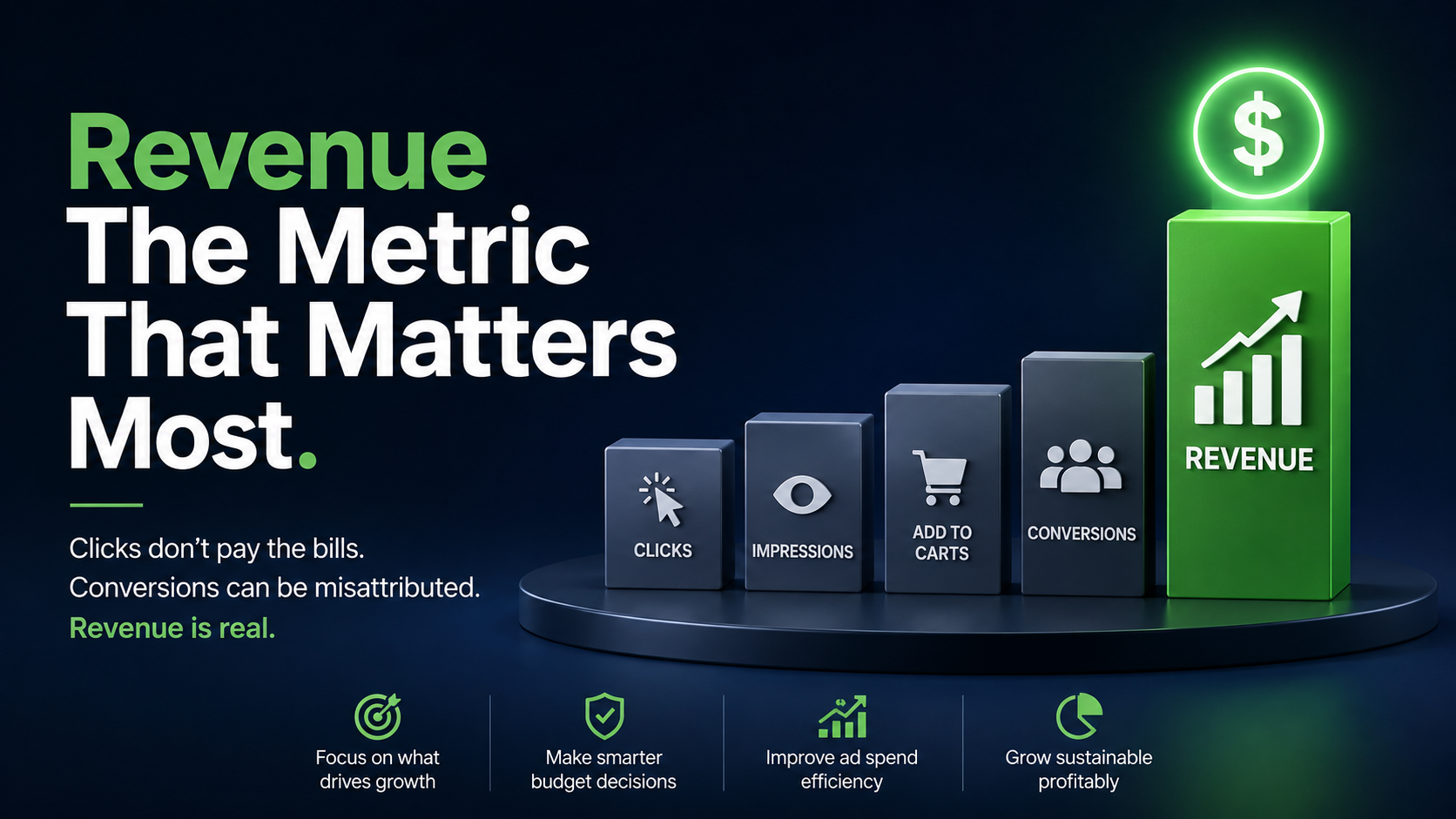
The one metric that hasn't changed is revenue.
Revenue can't be modelled, estimated or inflated through attribution. It's the clearest indication of whether your advertising investment is actually growing your business.
Why Marketing Attribution Has Become So Difficult
Ten years ago, digital attribution was relatively straightforward.
Today, customers interact with brands across dozens of touchpoints before making a purchase.
A typical customer journey might look like this:
Discover your brand through Instagram.
Watch a YouTube review a few days later.
Read your blog after searching Google.
Receive a remarketing advertisement.
Return directly to your website.
Purchase from another device.
Now add:
GDPR consent requirements
Apple's App Tracking Transparency (ATT)
iOS privacy changes
Cookie restrictions
Cross-device browsing
Ad blockers
Private browsing
Suddenly no single platform can accurately see the complete customer journey.
Every advertising platform is effectively looking at only part of the picture.
As third-party tracking continues to decline, marketers are increasingly relying on first-party data and broader measurement techniques to understand campaign performance. While attribution is becoming less precise, measuring overall business outcomes has never been more important.
What Is Data-Driven Attribution?
To compensate for missing tracking data, advertising platforms increasingly use data-driven attribution.
Rather than relying purely on observed customer journeys, machine learning models estimate how much each advertising interaction contributed to a conversion.
These models are sophisticated and continue to improve, but they remain statistical estimates.
The exact influence of an advertisement can rarely be known with complete certainty.
Each advertising platform also measures success using its own attribution model. As a result, Google, Meta and other platforms may each believe they contributed to the same purchase.
This isn't necessarily incorrect—it simply reflects the fact that each platform has visibility into different parts of the customer journey.
The important takeaway is that platform attribution should be treated as directional rather than absolute.
The question businesses should really be asking isn't "Which platform generated this sale?"
It's "Would this sale have happened without this advertising?"
This concept is known as incrementality, and it's becoming one of the most important ways to evaluate digital advertising as attribution becomes less reliable.
Why Platform ROAS Doesn't Tell the Whole Story
One of the most common mistakes businesses make is adding together the ROAS reported by each advertising platform.
Imagine this scenario.
A customer first discovers your business through a Meta advertisement.
They visit your website but don't buy.
Google later serves Search, Display, YouTube or Performance Max advertisements to that same customer through remarketing.
Eventually they purchase.
Meta reports a conversion.
Google also reports a conversion.
Both platforms may have genuinely influenced the outcome.
But your ecommerce platform only records one sale.
This is why platform-reported ROAS frequently differs from actual business performance.
Looking at Google Ads and Meta Ads independently can often paint an overly optimistic picture. While both platforms provide valuable insights for campaign optimisation, neither should be treated as your single source of truth.
What Is Google Performance Max?
One of Google's biggest strategic shifts has been the introduction of Performance Max (PMax).
Performance Max is Google's AI-powered campaign type that automatically serves advertisements across almost every Google property, including:
Google Search
Google Shopping
Display Network
YouTube
Discover
Gmail
Google Maps
Instead of advertisers manually selecting keywords, audiences, placements and bidding strategies, Google increasingly makes those decisions automatically using AI.
The idea is simple:
Provide Google with your creative assets, products, conversion goals and budget, then allow its algorithms to determine where, when and who to advertise to in order to maximise conversions.
For many advertisers, Performance Max can deliver excellent results.
However, it also represents a major shift towards a more automated, hands-off approach to campaign management.
Google continues encouraging advertisers to adopt AI-driven automation across Google Ads, signalling that this is the future direction of digital advertising.
While automation reduces complexity and can improve campaign performance, it also gives advertisers less visibility into exactly how budgets are allocated and what tactics are generating results.
As automation increases, measuring business outcomes becomes even more important than measuring individual campaign metrics.
Should You Include Brand Searches in Performance Max?
One topic that continues to generate discussion is branded search traffic.
Without careful configuration, Performance Max may bid on searches containing your own company or brand name.
These campaigns often produce exceptional conversion rates because people searching specifically for your business already have strong purchase intent.
Many of these users may have found your business through:
Organic search
Previous advertising campaigns
Email marketing
Social media
Word-of-mouth
Direct website visits
In these situations, it's difficult to determine whether the paid advertisement generated additional demand or simply intercepted customers who were already intending to purchase.
Whether branded campaigns should be included depends on your competitive landscape, customer behaviour and marketing strategy.
There is no universal right answer.
The important point is understanding what those conversions actually represent before using them to judge advertising performance.
Digital Advertising Still Works—Despite Attribution Challenges
Reading about attribution challenges sometimes leads people to an incorrect conclusion:
"Maybe digital advertising doesn't work anymore."
The opposite is generally true.
If most ecommerce businesses paused all of their advertising tomorrow, they would likely experience a gradual decline in traffic, new customer acquisition and revenue over time.
Digital advertising remains one of the most effective ways to reach new customers, build awareness and generate sales.
The challenge isn't proving that advertising works.
The challenge is accurately measuring how much each marketing activity contributed.
Why Revenue Should Be Your Source of Truth
This is why revenue should sit at the centre of every marketing dashboard.
Unlike platform metrics:
Revenue cannot be estimated.
Revenue cannot be duplicated across multiple platforms.
Revenue cannot be inflated by attribution models.
Revenue represents what actually happened.
Instead of evaluating Google Ads, Meta Ads and other advertising platforms independently, businesses should compare:
Total ecommerce revenue
Total advertising spend across every platform
Overall blended ROAS
Blended ROAS measures your total revenue against your total advertising investment, regardless of which platform claims the conversion.
It answers the question that matters most:
"How much revenue did the business generate for every advertising dollar spent?"
This provides a much clearer picture of overall marketing effectiveness than relying solely on platform-reported ROAS.
Campaign Metrics Are Important—But Revenue Comes First
Metrics such as:
Click-Through Rate (CTR)
Cost Per Click (CPC)
Conversion Rate
Engagement Rate
Video Views
Add-to-Carts
Cost Per Acquisition (CPA)
Platform ROAS
are all valuable.
They help identify:
Creative opportunities
Audience quality
Landing page issues
Campaign optimisation opportunities
But they are diagnostic metrics—not business outcomes.
A campaign can have exceptional click-through rates and still fail to grow the business.
Likewise, a campaign can generate thousands of conversions inside an advertising platform while overall revenue remains flat.
Without sustainable revenue growth, none of these metrics ultimately matter.
Revenue remains the metric that keeps the business operating.
How Admeriq Measures Marketing Performance
At Admeriq, we believe your revenue should be your source of truth.
Rather than focusing solely on what individual advertising platforms report, Admeriq calculates your blended ROAS by comparing your actual ecommerce revenue against your total advertising spend across every platform.
This provides a far more realistic understanding of marketing performance by cutting through fragmented attribution models and platform-specific reporting.
Admeriq helps businesses answer the questions that really matter:
Is our advertising investment generating profitable growth?
Are we becoming more efficient over time?
Is increasing ad spend actually increasing revenue?
Are platform-reported conversions reflected in real business results?
Is my agency actually running my ads efficiently?
By putting revenue at the centre of reporting, businesses gain a clearer understanding of marketing effectiveness and can make more confident investment decisions.
Because at the end of the day, impressions don't pay the bills.
Clicks don't pay the bills.
Even platform-reported conversions don't always tell the full story.
Revenue does.
Frequently Asked Questions
What is blended ROAS?
Blended ROAS (Return on Ad Spend) measures your total business revenue divided by your total advertising spend across all advertising channels. Unlike platform ROAS, it doesn't rely on attribution models and provides a more accurate picture of overall marketing performance.
Why do Google Ads and Meta Ads both claim the same conversion?
Each advertising platform tracks different parts of the customer journey using its own attribution model. If a customer interacts with advertisements across multiple platforms before purchasing, each platform may legitimately claim credit for that conversion.
What is data-driven attribution?
Data-driven attribution uses machine learning to estimate how much each advertising interaction contributed to a conversion. It helps fill gaps caused by privacy restrictions and incomplete tracking but should be viewed as an estimate rather than an exact measurement.
What is Google Performance Max?
Performance Max is Google's AI-powered campaign type that automatically delivers advertisements across Search, Shopping, Display, YouTube, Discover, Gmail and Maps using a single campaign. Google's AI determines where your ads appear and how your budget is allocated.
Should I exclude my brand name from Google Ads?
It depends on your objectives and competitive landscape. Branded campaigns can defend your brand against competitors and capture high-intent traffic, but they can also inflate reported campaign performance because many branded searches may have converted through organic channels anyway.
What is incrementality in digital advertising?
Incrementality measures whether a sale would have happened without your advertising. Rather than asking which platform received credit, incrementality focuses on whether your advertising created additional business outcomes that otherwise would not have occurred.
Why is revenue more important than platform ROAS?
Revenue reflects actual business performance. Platform ROAS depends on attribution models that can overstate performance or duplicate conversions across multiple platforms. Revenue provides a single, objective source of truth.
Can digital advertising still be measured accurately?
Yes, but measurement has evolved. Rather than relying solely on attribution, businesses should combine platform insights with first-party data, blended ROAS, revenue reporting and broader measurement approaches to understand marketing effectiveness.
What metrics should I monitor alongside revenue?
Revenue should remain your primary KPI, supported by metrics such as blended ROAS, CTR, CPA, conversion rate, customer acquisition cost (CAC), average order value (AOV) and customer lifetime value (LTV).
How does Admeriq help measure marketing performance?
Admeriq combines your ecommerce revenue with advertising spend across all platforms to calculate blended ROAS and provide a single view of marketing performance. This helps businesses evaluate advertising based on real business outcomes rather than platform-reported attribution.