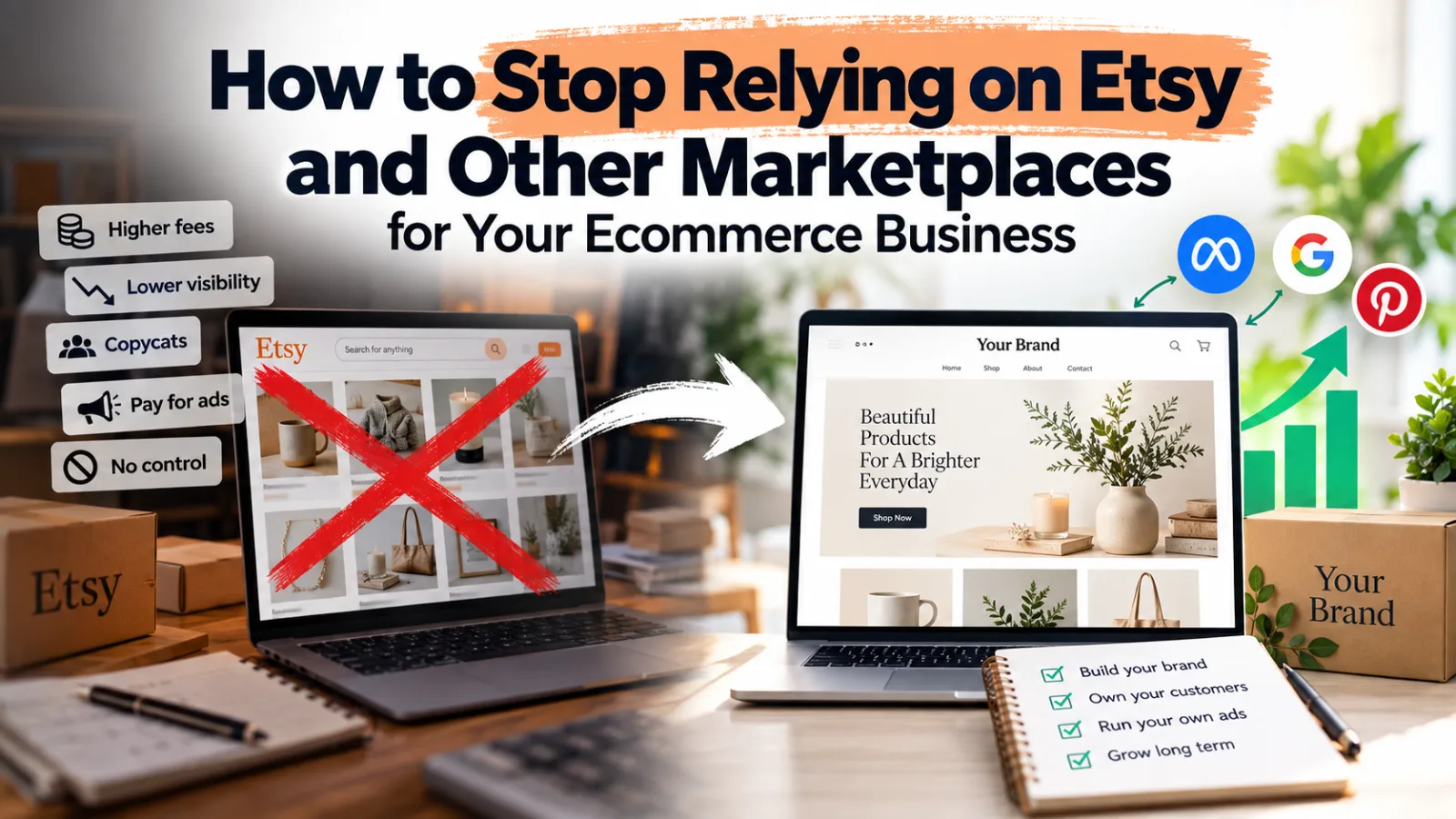
There are more sellers competing for attention, copycat products are easier to create and distribute, and many established stores are finding that organic visibility is harder to maintain. At the same time, the cost of selling through marketplaces can add up quickly through transaction fees, advertising fees and other platform costs.
The bigger issue is that when your business depends entirely on Etsy, you don't really own the customer relationship.
Etsy owns the marketplace, controls much of the customer experience, determines how products are surfaced in search and can change its fees, policies and algorithms at any time.
That creates a problem: you can spend years building a successful store on a marketplace without building an equally valuable asset of your own.
The marketplace trap
Marketplaces are incredibly useful when you're starting out.
You can create an account, upload some products and potentially get your first customers without having to build a website, establish a brand or generate your own traffic.
The problem comes when the marketplace becomes your entire business.
Your customers are buying through Etsy rather than directly from your brand. Your store exists inside Etsy's ecosystem, your visibility is influenced by Etsy's algorithm and your ability to reach customers is constrained by the platform's rules.
This means that if Etsy changes how search works, increases fees or changes its advertising products, you have limited control over what happens next.
It's similar to building a physical retail business inside somebody else's shopping centre. You benefit from the foot traffic, but the shopping centre owner controls the environment around you.
Rising costs make the equation even more important
Etsy's transaction fee has increased from 5% to 6.5%, while sellers can also incur advertising costs and other fees depending on how they use the platform.
Offsite Ads are a particularly important consideration.
If a customer discovers your product through Etsy's advertising ecosystem, you may have to pay an advertising fee when that sale occurs. The customer relationship, however, still remains within Etsy.
The fundamental question for a growing business is therefore:
If you're already paying to acquire customers, why not use that investment to build your own brand and customer base?
That doesn't necessarily mean abandoning Etsy. Etsy can continue to be a valuable acquisition channel. The goal is to stop treating it as the only place where your business exists.
Build your own ecommerce store
If you're serious about reducing your dependence on Etsy, the first step is to build a store that you control.
Platforms such as Shopify and WooCommerce have made this considerably easier than it used to be.
You don't necessarily need a large custom-built ecommerce website costing tens of thousands of dollars.
For many smaller ecommerce businesses, a relatively simple store is enough to get started:
A professional homepage
Product pages
A shopping cart and checkout
Payment processing
Shipping information
About page
Contact information
Email signup
Basic analytics and conversion tracking
Search engine optimisation
Links to your social media profiles
The important thing is not to spend months trying to build the perfect website before you launch.
Get the fundamentals working, start sending traffic to it and improve the store based on what you learn.
AI has changed the economics of running a store
This is where things get particularly interesting.
Tasks that previously required a developer, designer or freelancer can now often be completed with AI assistance.
For example, you can use tools such as Claude to help you understand your ecommerce platform, write code, troubleshoot problems and make changes to your website.
You can ask an AI assistant questions such as:
"I want to change the layout of my Shopify product page. Explain what files or settings control this and show me how to make the change."
Or:
"I want to add an email capture popup to my website that appears after someone has spent 30 seconds on a product page. How would I implement this?"
The important distinction is that AI isn't necessarily replacing the ecommerce platform. Instead, it can act as a technical assistant that helps you understand and modify the platform.
For someone who isn't a developer, this can significantly reduce the cost and friction of making changes.
You should still review changes before deploying them, particularly when they involve checkout, payments, customer data, security or anything that could affect your ability to take orders.
Why pay to advertise someone else's marketplace?
Once you have your own store, you can start thinking differently about advertising.
Instead of paying Etsy to help generate sales that happen inside Etsy, you can send traffic directly to your own website through channels such as Google Ads, Meta Ads, Pinterest, TikTok or other platforms that make sense for your products.
The economics aren't automatically better. Advertising your own store means you are responsible for acquiring the customer, converting them and paying for the technology required to operate the store.
But there is an important difference.
You are building an asset that you control.
When somebody buys from your website, you can build a direct customer relationship, subject to privacy and marketing laws. You can encourage them to join your email list, introduce them to other products, offer loyalty incentives and bring them back to your website for future purchases.
That second and third purchase can be extremely important.
If you acquire a customer once and they subsequently purchase directly from you several more times, the economics of customer acquisition can look very different from a marketplace transaction where you continually operate within the marketplace's rules and fees.
Don't abandon Etsy overnight
There's no reason you necessarily need to choose between Etsy and your own website.
In fact, for many businesses the better approach is to use both.
Think of Etsy as one sales channel rather than your entire business.
You can continue selling your products on Etsy while gradually building your own store.
For example, you could:
Build your Shopify or WooCommerce store.
Add your existing products.
Improve your product photography and descriptions.
Set up analytics and conversion tracking.
Start building an email list.
Test small advertising campaigns.
Create content around your products and brand.
Encourage customers to discover your brand outside Etsy.
Gradually increase the percentage of sales coming through your own website.
This approach reduces the risk of suddenly cutting off an existing source of revenue.
The objective isn't necessarily to eliminate Etsy. The objective is to make sure your business can survive without it.
Should you run your own advertising?
This depends heavily on your time, interest and technical ability.
Most ecommerce business owners fall into roughly three categories.
1. You don't have enough time
You're already busy running the business, managing suppliers, fulfilling orders, answering customers and developing new products.
Learning Meta Ads, Google Ads, analytics and conversion tracking isn't realistic.
In this situation, using an experienced freelancer or advertising agency may make sense. There are, however, downsides to outsourcing your advertising, particularly if you don't understand enough about the fundamentals to know whether the agency is actually doing a good job.
Before handing over your advertising budget, understand what you're paying for and how performance will be measured. This guide on how to know if your digital marketing agency is effective at online advertising covers some of the things to look for.
2. You have some time but don't enjoy technical work
You may be interested in growing the business but don't want to spend your evenings learning code, configuring analytics or troubleshooting website problems.
This is where AI can be particularly useful.
Instead of paying somebody every time you need a relatively small technical change, you can use AI to explain the process, generate the code and help troubleshoot problems.
You can then spend your time on the parts of the business that actually require your expertise.
If you do use a freelancer or developer, you should also be asking how they are using AI to improve their productivity.
The economics of development have changed significantly. A task that might previously have taken days could potentially be completed much faster with AI assistance.
That doesn't mean every task should be instant, or that AI eliminates the need for experienced developers. It does mean that businesses should be questioning whether they are paying traditional rates for work that can now be completed much more efficiently.
3. You have time and enjoy being hands-on
This is where AI can potentially have the biggest impact.
If you enjoy learning how your website works, experimenting with advertising and making changes yourself, AI can become something like an on-demand technical assistant.
You don't need to become a professional developer.
Instead, you can learn enough to understand how your store works and then use AI to help you solve individual problems.
With tools a such as Admeriq it can help you keep advertising costs under control by comparing it to your revenue.
What can AI actually do for your ecommerce store?
Once you've connected your AI development tools to your website and understand the basics, the possibilities become much broader.
For example, AI can help you:
Create and optimise product pages
You can provide your product information and images and ask AI to help create:
Product descriptions
Meta titles
Meta descriptions
Product specifications
FAQ content
Structured product information
Internal links
SEO-friendly page copy
You still need to review the output. AI can make mistakes, invent specifications or produce generic copy if you don't give it enough information.
The advantage is that it can dramatically reduce the amount of time required to create and maintain large numbers of product pages.
Create new website layouts
You can also use AI to experiment with different page layouts.
For example, you could ask it to create a product page that places reviews closer to the purchase button, moves product specifications further down the page or changes how related products are displayed.
You can then test different versions and use your analytics to determine which changes actually improve conversion rates.
The important part is testing rather than assuming.
AI can create a new design. Your customers ultimately determine whether that design works.
Build simple ecommerce features
There are also many smaller features that previously required installing a third-party app.
Depending on your ecommerce platform and technical setup, AI can help you build things such as:
Multi-currency functionality
Country restrictions
IP-based blocking
Email capture popups
Custom product filters
Product recommendation components
Custom shipping messages
Stock notifications
Custom promotional banners
Simple calculators
Custom forms
This doesn't mean you should build everything yourself.
For complex functionality involving payments, security, customer data or critical ecommerce operations, an established application or experienced developer may still be the better option.
But for smaller custom features, the economics have changed.
You may not need as many monthly apps
One of the less obvious benefits of learning to work with AI and your ecommerce platform is that you may be able to reduce the number of small apps you pay for every month.
Ecommerce businesses can gradually accumulate dozens of subscriptions.
One app handles a popup. Another handles a product badge. Another adds a custom form. Another modifies the product page.
Individually, these subscriptions might only cost $10, $20 or $30 per month.
Over several years, however, they can become a significant operating expense.
If a simple feature can be built directly into your store, it may make sense to do that rather than adding another monthly subscription.
Again, this isn't a rule that every app should be replaced with custom code.
Established apps can save enormous amounts of development time and may provide better support, reliability and functionality. For complicated systems, paying for an established solution can be the smarter option.
The point is to understand that you now have another option.
Start building an asset you actually own
The biggest reason to build your own ecommerce store isn't simply to save a few percentage points on fees.
It's to build something that becomes more valuable as your business grows.
Your brand.
Your website.
Your customer relationships.
Your email list.
Your customer data.
Your content.
Your organic search presence.
Your advertising audiences.
Your repeat customers.
Your product reviews.
Your reputation.
These are assets that can continue working for you regardless of whether Etsy changes its algorithm, increases its fees or changes its advertising model.
You can still use Etsy. You can still use Amazon. You can still use other marketplaces.
But they should ideally become channels for your business rather than the foundation of your business.
The goal isn't to stop using marketplaces.
The goal is to make sure you don't depend on them.